Orbital Angular Momentum (OAM) Beam Generation Using Simple Ring Patch Antenna for IoT Applications
ID:60
Submission ID:378 View Protection:ATTENDEE
Updated Time:2026-07-22 16:09:32 Hits:23
Online
Start Time:2026-07-30 15:40 (Asia/Kolkata)
Duration:15min
Session:[S1] 5G and beyond Wireless Networks » [S1-2] 5G and beyond Wireless Networks
Video
No Permission
Presentation File
Attachment File
Tips: The file permissions under this presentation are only for participants. You have not logged in yet and cannot view it temporarily.
Abstract
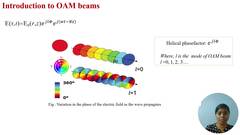
This paper presents the design of a compact circular ring patch antenna for generating orbital angular momentum (OAM) mode at 5 GHz. The TM21 mode is created by feeding a circular ring patch with a coaxial probe. The proposed antenna is very simple and compact for producing an OAM mode (l = 1), as it only includes one circular ring. All parameters of the proposed antenna are obtained from CST Microwave Studio, such as reflection coefficient (S11), radiation characteristics, electric field distribution, and phase distribution. Simulated results show that there is good impedance matching at 5 GHz with S11 less than −10dB. Theradiation pattern exhibits a doughnut-shaped profile with a null along the beam axis, which is a characteristic feature of OAM beams. The phase distribution is continuous over the entire azimuthal range of 0◦–360◦, as observed from a central point, resulting in a helical wavefront corresponding to the OAM mode (l = 1). This antenna configuration represents a low-profile and compact approach to generate OAM. It exhibits a maximum gain of around 10 dB and a radiation efficiency of approximately 90%. Due to its ease of integration with existing technologies, the proposed design can be considered a viable candidate for applications in OAM-based wireless communication systems.
Keywords
Orbital angular momentum (OAM), ring patch antenna, TM21 mode
Speaker

Comment submit