Enhancing Multi-Agent LLM Output Quality Through Adversarial Critique: A Cross-Domain Evaluation
ID:70
Submission ID:421 View Protection:ATTENDEE
Updated Time:2026-07-22 16:09:38 Hits:48
Online
Start Time:2026-07-31 12:10 (Asia/Kolkata)
Duration:15min
Session:[S6] Artificial Intelligence Use Cases » [S6-4] Artificial Intelligence Use Cases
Video
No Permission
Presentation File
Tips: The file permissions under this presentation are only for participants. You have not logged in yet and cannot view it temporarily.
Abstract
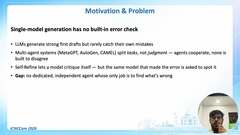
Multi-agent large language model (LLM) systems have shown promising results by dividing tasks among multiple agents with different roles. However, many existing approaches
focus mainly on collaboration and lack a dedicated mechanism for critically evaluating and improving generated responses. In this article, a multi-agent framework known as AdversarialMAS is introduced, which presents an adversarial critique stage to improve output quality. The framework consists of a Generator Agent that creates an initial response, a Critic Agent that analyzes the response, and a Revision Agent that refines the final output based on the feedback. Further AdversarialMAS is evaluated against three approaches: a Single-Agent LLM, a Sequential Multi-Agent pipeline, and a Self-Refine method. The evaluation is conducted across three domains—startup strategy development, research proposal generation, and software system design. Experimental results from automated metrics and LLMbased evaluation show that the proposed approach achieves the highest overall score of 4.19, with improvements in consistency, completeness, and faithfulness. The results suggest that adversarial critique can be an effective approach for improving the reliability and quality of multi-agent LLM outputs.
focus mainly on collaboration and lack a dedicated mechanism for critically evaluating and improving generated responses. In this article, a multi-agent framework known as AdversarialMAS is introduced, which presents an adversarial critique stage to improve output quality. The framework consists of a Generator Agent that creates an initial response, a Critic Agent that analyzes the response, and a Revision Agent that refines the final output based on the feedback. Further AdversarialMAS is evaluated against three approaches: a Single-Agent LLM, a Sequential Multi-Agent pipeline, and a Self-Refine method. The evaluation is conducted across three domains—startup strategy development, research proposal generation, and software system design. Experimental results from automated metrics and LLMbased evaluation show that the proposed approach achieves the highest overall score of 4.19, with improvements in consistency, completeness, and faithfulness. The results suggest that adversarial critique can be an effective approach for improving the reliability and quality of multi-agent LLM outputs.
Keywords
Multi-agent systems, Large Language Models, adversarial critique, iterative refinement, LLM evaluation
Speaker

Rohit Kumar Gupta
Assistant Professor Manipal University Jaipur
Comment submit